
Cate Osborn
Wildly Unprepared


Town Hall Seattle and UW Engage present
Gracie Rogers, Gretchen Stemmler, and Justin Applegate
EVENT NOTES
Doors for this event will open at 5:00 PM. This event is approximately 90 minutes long.
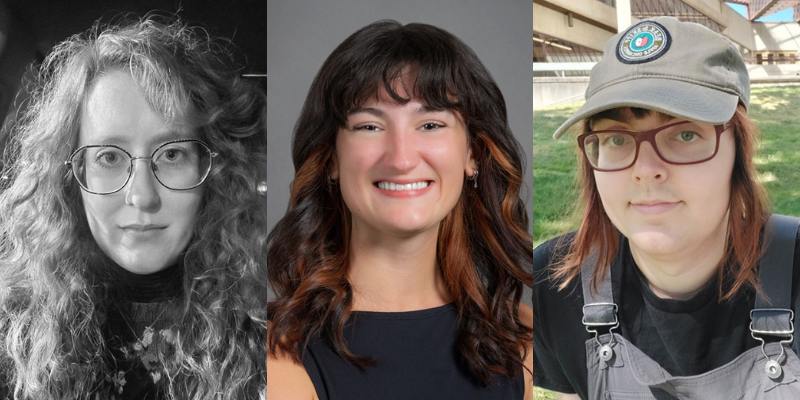
Hear from UW students about research on how biomimicry can be used to reduce pollution, how dopamine networks mediate motivation, and untreatable gonorrhea.
Gracie Rogers
In folklore, a golem is created to protect a community from danger. In this scientific retelling, the danger is rising atmospheric CO₂, and the guardians are synthetic molecules, peptoids, engineered to conduct carbon capture. Peptoids are bio-inspired proteins, built with structural changes to allow them to withstand harsh environments. When examining biology for pollution reduction, folks often think of plants. In this instance, the origin of the carbon capture in the peptoid molecules goes back to how shellfish build their shells. Shells are made from calcium carbonate. The ability of the natural protein to incorporate carbon is the inspiration.
My name is Gracie Rogers, I am studying for a PhD at the University of Washington. I hold a bachelor’s from Texas A&M University and a master’s from Villanova University, both in Chemical Engineering. While earning my degree at Villanova, I worked full-time in nuclear energy, where I learned that, with proper precautions, all science can be conducted safely. Outside of work and school, I enjoy crocheting, painting, and playing tennis.
Gretchen Stemmler
This talk investigates how brain dopamine networks mediate motivation and learning behaviors to design better pharmacological treatments for eating and mood disorders.
Current medications for affective disorders and eating disorders improve the regulation of brain reward systems that largely consist of dopamine circuitry. Dopamine neurons are robustly expressed in the brain and govern several adaptive behaviors, including reward learning, motivation, and movement. Dysfunction of dopamine systems can lead to various maladaptive behaviors characteristic of these disorders. However, current medications for affective and eating disorders affect widespread dopamine systems in nonspecific methods and have several off-target effects. My research examines genetic heterogeneity in dopamine neuron populations to identify the specific brain networks that govern natural reward, as well as how dysregulation of these dopamine networks is associated with affective and eating disorders. Ultimately, my research aims to support better pharmacological treatments through designing more specific medications that target only dysregulated brain systems to re-regulate their activity.
I am a first year pharmacology graduate student. I study the neural systems involved in motivation and reward learning using techniques such as neuromodulation, fluorescence imaging, and pharmacological methods. Through examining neural circuitry during natural and maladaptive behavior, I aim to identify specific molecular and circuit-level mechanisms to facilitate the development of treatment for individuals with addiction and mood-related disorders.
Justin Applegate
Gonorrhea has been plaguing humanity for most of our history. In the past 100 years, antibiotics have provided a safe and effective treatment for this disease. However, with the rise of antibiotic resistance, there is a looming threat of untreatable gonorrhea. In this talk, discover the ways we’ve treated gonorrhea throughout history, and potentially the future!
Dr. Justin Applegate, PhD is a recent graduate from the University of Washington Biochemistry Program. During their time in graduate school, they studied Type IV Pili, tiny fibers that bacteria use to cause infection.
Presented by Town Hall Seattle and UW Engage.

Events are offered for informational, entertainment, and educational purposes only. Read Town Hall’s Program Content Policy.
Thank you to our 2025-26 In-Kind Media Sponsor, Science in Seattle!

Wildly Unprepared
Town Hall Seattle and the Office of Mayor Wilson present
With Mayor Katie Wilson and Florangela Davila
Rental Partner: Whoome presents
The Golden Age of Arabic Music