Ellie Barber (a.k.a. Ollella) started her career as a musician early, singing before she could talk.
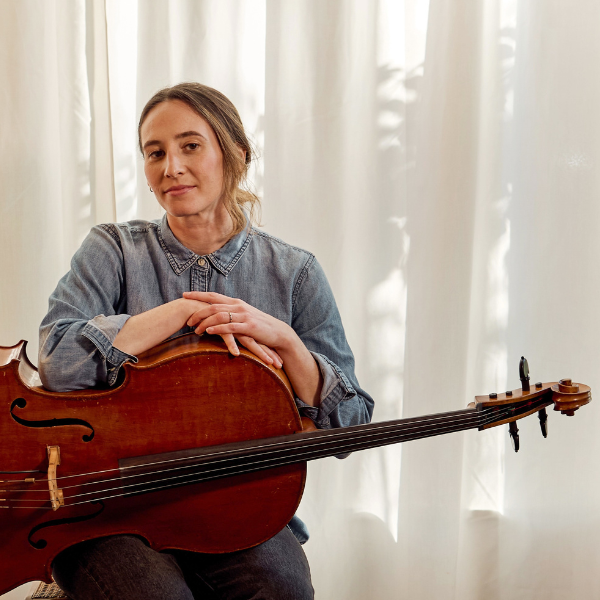
She has since created a life as a multidisciplinary artist as an indie-folk cellist, vocalist, and songwriter. Trained as a classical cellist since the age of nine, the Seattle musician merges her technical string background with authoritative vocals and live-looping. As Town Hall’s spring 2026 Artist-in-Residence, we chatted with Ellie about her upcoming residency, her history with Town Hall, and her exploration of sound.
What’s your connection to Town Hall? Have you played here or attended a concert before?
Growing up in the Seattle area, I played classical cello in school, but first and foremost loved alternative music. I’m lucky to say that my mom recognized and nourished that curiosity in my teens — whenever there was a Town Hall concert involving progressive strings, you would find us in the pews. As a result, Town Hall has that association for me: where string players come to play, experiment, and push traditional genres. Witnessing the rise of Joshua Roman (Former Town Music Artistic Director) in the Seattle scene was also an influential contributor, who, of course, has a storied relationship with Town Hall. He was a huge inspiration for me. I’ll never forget hearing him cover “Stairway to Heaven” with a cello quartet.
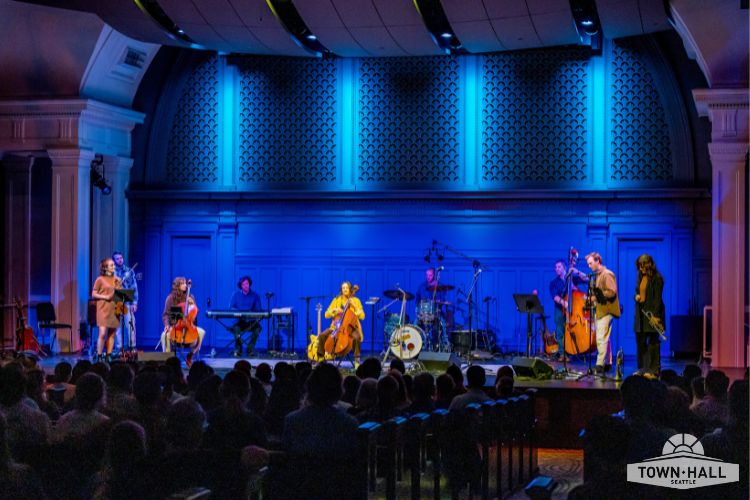
Because of that history, and the fact I’ve since developed into my own breed of “Alternative String Player,” it felt like a no-brainer to host my most recent album release show at Town Hall last year. For the show, I brought an 11-piece ensemble to the Great Hall: a rock band set up, but supplemented by additional strings, horns, and backup singers. Indie-rock bands don’t often have the opportunity to perform in large halls, and it got me thinking about creating new music composed with consideration for the architecture of the space it will be performed in.
What do you hope to discover during your residency?
The idea for this residency developed out of a moment during Ollella’s recent performance at Town Hall, when we performed one song acoustically amidst an otherwise fully amplified show. The emotional pull of that moment made me aware of how naturally the cello — and symphonic instruments more broadly — belong in the Great Hall, and how much the room itself shapes the emotional experience of the music. The instrument is made for the space, and the space is made for the instrument.
It maybe sounds silly, or obvious, but after performing amplified and almost exclusively in rock venues and clubs, I had forgotten that. The cello, in its natural wooden form, isn’t designed to be electrified. So when you do electrify it, it loses a certain amount of its soul — which I would argue is the instrument’s biggest strength.
The question I’m exploring in this residency is: What happens when you compose and arrange music with architectural history in mind, while also gently introducing sonic elements that challenge it? As someone working between the symphonic and alternative-rock genres, it’s exciting to consider how the architecture of a space influences the actual music written and performed.
When you’re writing a new song, where do you start? Is it about the instrument, the story, the setting, or something else entirely? What is your inspiration jumping-off point?
If I’m working on a new song, the process is very fluid. Every song is different, but usually it goes something like this:
- Sit down with a timer and freewrite on an idea/prompt/thought
- Write out some lyrics based on those words
- Pick up an instrument to find a melody/chord progression that fits
- Start humming
- Find a lyrical phrase/melody that sticks while humming
- Write new lyrics that center around the new sticky lyrical phrase
In the end, I often end up trashing the original lyrics I wrote in Step 2. But that’s part of the process — divorcing yourself from the final outcome is so important. It’s a very exploratory process for me.
What should folks expect when they come to an Ollella concert?
I see Ollella as a creative container more than a defined ‘band.’ Bon Iver calls his band, simply, “an art project based in Wisconsin” — I really relate to that. The form of Ollella is quite flexible, and collaboration is at the core of my ethos, so there are many iterations of the songs and band members.
Ultimately, my goal is for people to trust the artistic integrity of what Ollella stands for — whether it be a solo show with a looping pedal, or an 11-piece ensemble, as something interesting and stimulating to witness. It’s equally about the art itself as it is about the curious exploration of an art form.
See where the composition takes Ollella at her upcoming Scratch Night, Thursday, April 16, at 7:30PM. Click the button below to get tickets!