
About Us
Who We Are
Our Mission
Town Hall Seattle amplifies ideas, fosters civil discourse, and connects people through events in a vibrant historic building — inspiring lifelong learning, discovery, and dialogue.
Our Story
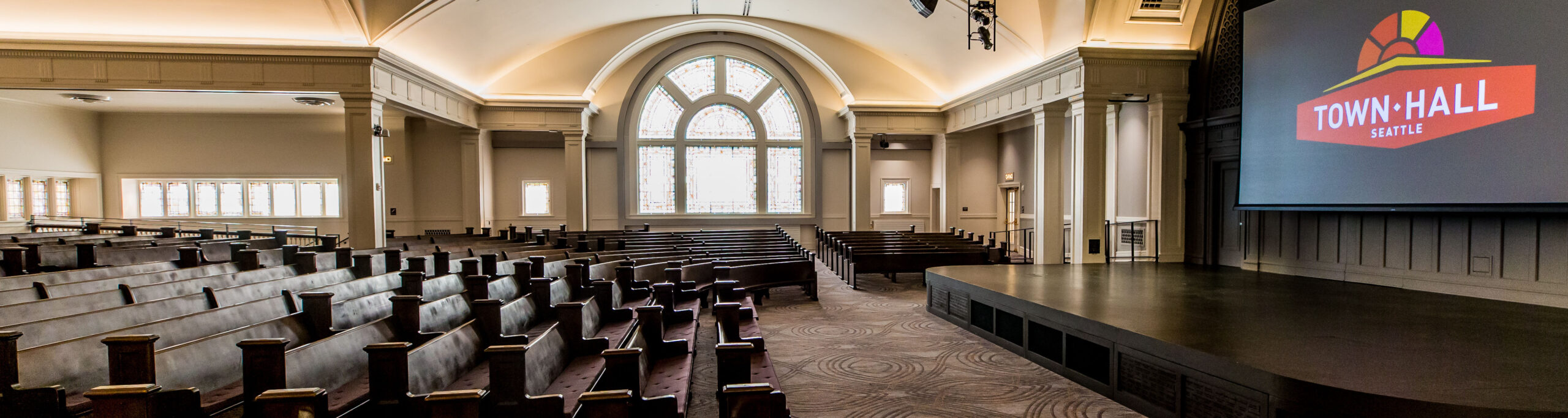
Founded as a nonprofit in 1998, Town Hall underwent a $35.5 million top-to-bottom renovation in 2019 and today serves as a vital community hub for curiosity and conversation. As both a venue and a producer, Town Hall creates space for independent voices, emerging thinkers, and world-class talent, making room for big ideas and the people engaging with them. Over 100,000 people gather at Town Hall annually for a unique mix of events produced by and for the community, from book talks and concerts to cultural conversations and civic dialogues.
Learn more about Town Hall’s history here.
Vision
Town Hall Seattle connects an engaged public through curiosity and conversation, ensuring equitable access to arts, culture, and the exchange of ideas.
Values
- Accessibility: Make programs, events, and spaces available to all, regardless of financial, physical, or
cultural barriers. - Collaboration: Partner with communities and organizations to create shared experiences that
center around inclusivity. - Connection: Bring people, ideas, and experiences together to build relationships, and strengthen community ties.
- Curiosity: Explore ideas, foster inspiration, and open pathways for discovery and lifelong learning.
- Equity: Expand access, share resources, and elevate marginalized voices to ensure fair participation and representation.
What We Believe
At Town Hall Seattle, we believe arts, culture, and ideas are for everyone to engage with. This is a space designed to feel open and inviting, where neighbors can come together to be curious, share their perspectives, and connect.
We also recognize that our work happens in a world shaped by inequities. To keep ourselves accountable, we hold four commitments at the center of our work.
Our Commitments
Land Acknowledgement
Town Hall’s Spring 2019 Artists/Scholars-in-Residence, Urban Native Education Alliance’s Clear Sky Native Youth Council (UNEA), created this Land Acknowledgement specific to our building in Downtown Seattle:
“We acknowledge that we are in the homeland of Chief Seattle’s dxw’dəwɁábš (People-of-the-Inside, the Duwamish Tribe of Indians), the First People of this land. The Duwamish are the first Indian Tribe named in the 1855 Point Elliott Treaty’s title. On January 22, 1855, Chief Seattle was the first signatory to the Point Elliott Treaty at Mukilteo. Three other chiefs signed the Point Elliott Treaty on behalf of the Duwamish Tribe. The Duwamish homeland extends from Lake Sammamish west to Elliott Bay, and from Mukilteo south to Federal Way, a total of 54,700 acres.
“The Snoqualmie, Suquamish, Tulalip and Muckleshoot Tribes are also sovereign nations indigenous to Puget Sound. Many people living at these sovereign nations and elsewhere are descendants of the Duwamish Tribe and have ancestral ties to this land.
“We raise our hands to honor Chief Seattle’s Duwamish Tribe of Indians and all descendants of the Duwamish Tribe. We thank them for their hospitality as the First People of this land, and for our continuing use of the natural resources of their Ancestral Homeland.
“Indigenous contributions and sacrifices are immense, and we acknowledge the ongoing disparities, racism, and political invisibility experienced by the Duwamish and other Indigenous Peoples of Puget Sound.”
The UNEA residents also created the verbal land acknowledgement read aloud during the introduction to Town Hall-produced events:
“We acknowledge our institution stands on the unceded traditional territory of the Coast Salish people, particularly the Duwamish. We thank them for our continuing use of the natural resources of their Ancestral Homeland.”
Participants from the UNEA community involved in creating this Land Acknowledgement included Alexander (Assiniboine) , Asia (Cherokee), Alex (Menominee), Akichita (Standing Rock Lakota), Chayton (Hunkpapa Lakota), Cante (Hunkpapa Lakota), Snoqualmie Tribe Chief Andy De Los Angeles, Snoqualmie Tribe member Sabeqwa De Los Angeles, past UNEA program director & Clear Sky Co-Coordinator AJ Oguara (Colville confederated tribes), and past UNEA Elder Tom Speer.
To learn more about the process of developing the Land Acknowledgement, visit the Town Hall blog.
Racial Equity Statement
Updated January 2026
Town Hall Seattle’s goal is to be a shared community resource where everyone is welcomed, valued, and has access to our stages and programs. We are dedicated to fostering an anti-racist, inclusive, and equitable environment, and recognize that:
- structural racism — and its intersections with classism, ableism, sexism, colonialism, and other forms of oppression — has shaped cultural institutions, including our own.
- Town Hall has a responsibility to stand up to exclusion, hate, and discrimination.
- to interrupt systems that perpetuate harm against Black, Indigenous, and People of Color (BIPOC) and other marginalized communities, we must actively practice equity.
Town Hall is committed to equity in everything we do, from how we make decisions and operate our organization, to how we produce programs and collaborate with partners. Our organization-wide commitments include:
- reviewing and improving internal practices to ensure our staff and board reflect and actively support our values of diversity, equity, inclusion, and belonging.
- producing programs that amplify and reflect the diverse voices and perspectives of people in our city and region.
- intentionally expanding our network of collaborators to include a broader range of organizations, speakers, artists, and voices.
- prioritizing accessibility to ensure that everyone — patrons, artists, speakers, vendors, and staff — can comfortably use the Town Hall building and experience programming.
Town Hall’s board and staff share responsibility for advancing this work. Together, we aim to build a culture that supports learning, accountability, and lasting change across the organization.
We’re committed to the continual examination of this statement and listening to community members. To learn more about specific efforts and department-focused commitments, or to reach out with feedback, questions, or ideas, please contact us at info@townhallseattle.org.
Community Code of Conduct
Updated September 2025
Town Hall is a shared space for curiosity, learning, and connection. Entering a shared space comes with shared responsibility: to help ensure Town Hall is a place where everyone feels respected and welcome.
We ask everyone — audiences, presenters, artists, staff, and guests — to:
- Engage thoughtfully
- Remain open to different points of view
- Treat others with respect
Code of Conduct
Hate speech is not permitted. Hate speech includes language that attacks, threatens, or demeans any person or group based on sex, gender, race, sexuality, disability, age, religion, country of origin, or background.
Harassment is not tolerated. Harassment includes bullying, intimidation, stalking, unwelcome physical contact, or language that reinforces systems of oppression.
If You Experience or Witness Harm
If you witness or experience hate speech or harassment, alert a staff member or report the incident to access@townhallseattle.org. All reports are taken seriously.
Town Hall creates space for a range of ideas and expects civility. Our mission includes bringing many perspectives to the stage. Some of the ideas presented here may be challenging or unsettling. Responses to ideas — and to one another — must be grounded in care and respect.
Town Hall is a nonprofit cultural venue and civic space. We do not endorse the views of our speakers, guests, or rental partners. Our role is to provide a platform for public discourse. But let us be clear: civil rights, identity, and humanity are not up for debate.
Thank you for helping make Town Hall a place where ideas are explored — and where everyone belongs. If you ever feel unsafe or unwelcome in our space, please contact us at access@townhallseattle.org.
Accessibility Statement
Town Hall Seattle is committed to accessibility for audiences and artists alike. From our ticketing policies to the capacities of our physical space, our goal is for Town Hall to be a place where everyone can take part, be inspired, and use their voice to shape our future.
Our Venue
In 2019, Town Hall Seattle completed a $35 million renovation, providing an even more accessible home for our city’s conversations and creativity. Core accessibility features of the renovation include:
- At-grade entrances (8th Ave Entrance to The Lobby, and West Entrance facing Downtown Seattle)
- Restrooms for all genders and bodies. Our building features 17 all-gender restrooms on our lobby level, as well as ADA-accessible restrooms on the lobby and Forum level
- Church pew/bench seats with wheelchair and companion seating in The Great Hall, and variable/movable seating in The Wyncote NW Forum and The Mehdi Reading Room
- A modern, spacious elevator serving all three levels of the building and a wheelchair lift for speaker access to the Forum green room
- Wheelchair ramp leading to the Forum Stage and wheelchair access via the elevator to the Great Hall stage
- Accessible backstage areas, restrooms, and green rooms serviced by an elevator
- Speaker and presenter seating for all bodies and abilities
- A Hearing Loop system in all three performance spaces. Using T-Coil (wireless receiver) technology, the hearing loop system projects voices and sounds directly from the microphone into an individual’s hearing aid.
- Braille on permanent room signage throughout the building
A Note on Transportation and Parking
Town Hall Seattle does not have a designated parking lot. Our venue is served by frequent bus routes, is near access to light rail stations, and close to a number of parking options nearby – including discounted, ADA parking at LAZ Parking (6th Ave Coast Seattle Downtown Hotel Garage). Learn more about parking options and discounted parking nearby here.
Program Accessibility & Livestreaming
Town Hall strives to ensure that all audience members can participate fully in our programs. We make every effort to provide real-time captioning (CART), ASL interpretation, translation and transcription services, and seating accommodations upon request.
Town Hall currently provides livestreaming for select events. An event may be livestreamed under any of the following circumstances:
- In-person tickets to the event are sold out or anticipated to sell out
- Livestreaming is requested by a speaker or co-presenting partner
- Livestreaming is requested by a ticket buyer
- The event topic is relevant to disability or disability justice
Audio and/or video recordings of most Town Hall-produced programs are available to the public approximately 2 weeks after the initial event date. You can find Town Hall’s digital content by visiting the Audio & Video Archives, and by subscribing to our podcasts and YouTube channel.
We do our best to honor livestream requests, pending staffing and permission from speakers and publishers. Contact access@townhallseattle.org to request accessibility services, ask questions, or to let us know what other accommodation you need to participate fully. Please provide at least 2 weeks’ advance notice when requesting CART and Livestreaming, and at least 4 weeks’ notice when requesting ASL.
For more information about our entrances, accessibility requests, and more, check out our Plan Your Visit pages.
Economic Accessibility
Town Hall strives to ensure that the cost of admission is never a barrier to participation. Almost all Town Hall-produced events are available on a sliding scale starting at $10, and many events are free. To break down further barriers to access, our 22 & Under initiative launched in 2019 with support from the Seattle Office of Arts & Culture, making most Town Hall-produced programs free for everyone aged 22 & Under.
If the ticket price to a Town Hall-produced program poses a barrier for you, please contact patronservices@townhallseattle.org for economic accommodations.
Economic Access for Rental Partners: We operate our stages with the same deep commitment to economic accessibility; our performance spaces are the most affordable in the region among similarly sized venues. We underwrite rental rates and related services for other small and midsized nonprofits and mission-aligned producers to help level the cultural playing field and ensure that everyone can afford to take the stage.
Note: Town Hall does not set the ticket prices for Rental Partner events. Our sliding scale ticketing model and 22 & Under tickets do not extend to programs produced by Rental Partners. To identify rental events, look for the gray “Rental Partner” label on our website and printed calendar.
Town Hall values active collaboration with our community, and our commitment to accessibility is no different. We invite you to contact us with feedback and ideas.
Join the Conversation
Town Hall Seattle is your place to listen, learn, and engage with your city. As we look towards the future, we encourage you to explore our programs, connect with new ideas, and share your voice with us.
Financials
Town Hall Association is a registered 501(c)(3) not-for-profit organization. All donations are tax deductible to the full extend of the law. Town Hall is not affiliated with the City of Seattle or any government agency.